/ 4 min read
Ioma's pack
2026-11-04. The game turns toward Ioma, and she gets a pack: see a thing, read it, take it, carry it.
The brief changed today (v0.5). Lowwater is no longer a real-time strategy game: the player is Ioma, the people around her act on their own and sometimes on her word, and nobody is selected or taken over. Winning still takes strategy, and much of it now runs through what she carries. Water stays at the centre, but it is no longer the only thing that matters: food for long crossings, tools to build and mend, and weapons lie about the land, and the player decides whether she picks them up.
The pack was designed in conversation over browser mockups (docs/superpowers/specs/2026-11-04-ioma-pack-design.md) and built the same day in a bare test scene of its own, -LwSet=TestScene=pack: a stretch of the old dune ground in daylight, Ioma on foot from the first frame, eight items on the sand.
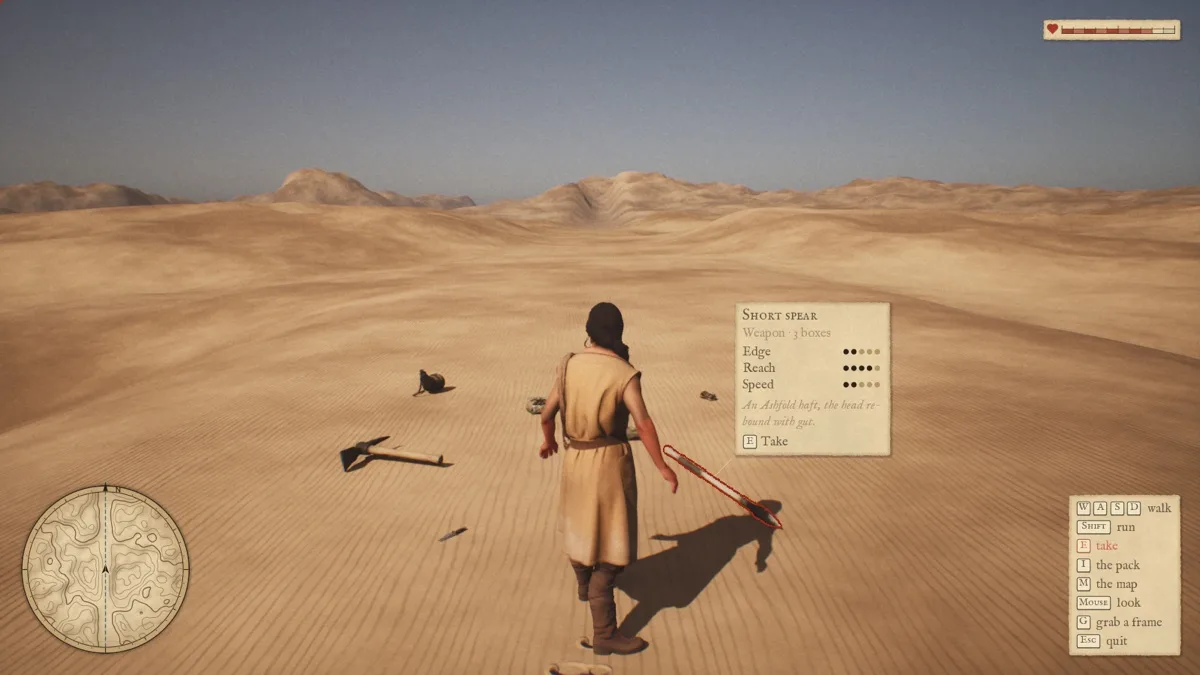
Walking up to the items: the one in her reach nearest the middle of the view is outlined in red ink, and a paper tag hangs beside it. E takes it.
Seeing before taking. Whatever lies within 2.5 m of her and nearest the middle of the view is outlined in the HUD's red annotation ink (a post-process on the custom stencil, so it holds its colour in any light), and a tag of the HUD's paper hangs beside it with a leader line: the name in small caps, the kind and the room it takes, its attributes as dots out of five or a few words, and a line of its history in italic. The attributes are made up for now; what they do comes with travel, building and fighting.
Room, not weight. The pack is twelve equal boxes. A knife takes one, the dates two, a full waterskin three, the mattock four. The first mockups sized each item's box by its bulk and looked untidy; equal boxes with the heavy thing hatching the ones it also fills read like a well-kept grid and still make the mattock cost what it should.
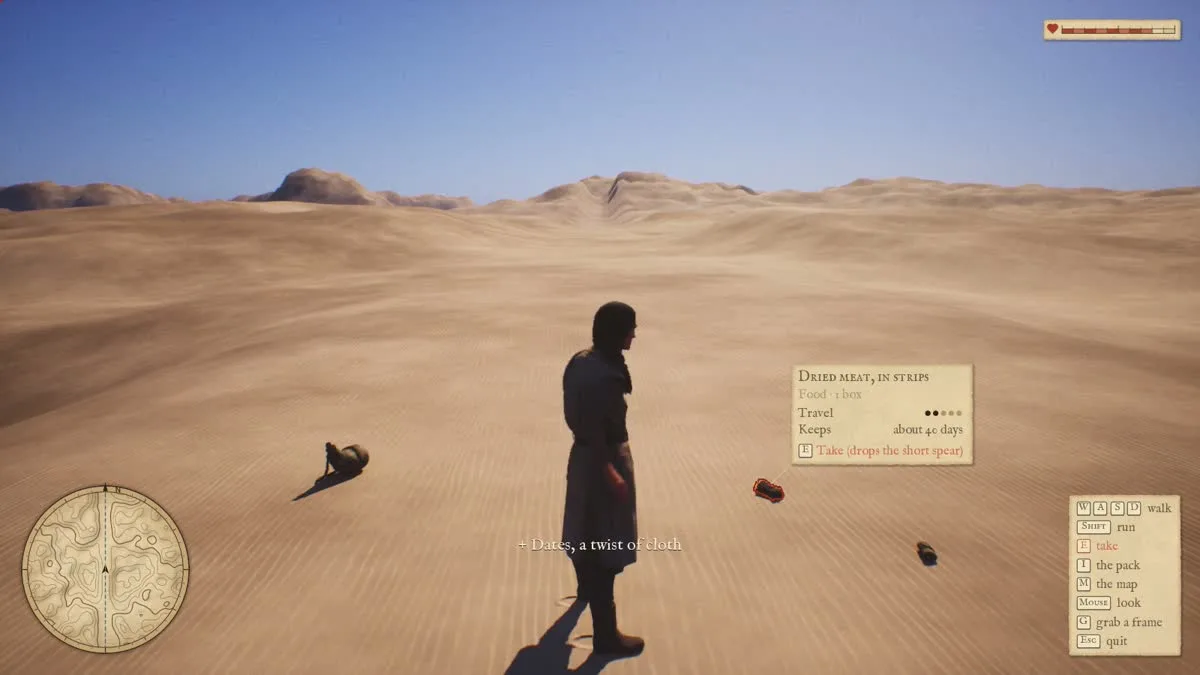
With the pack full, the tag says what taking the dried meat will cost before the key is pressed: the short spear, the oldest thing she carries.
Nothing lost silently. When something won't fit, the oldest things she carries are set down at her feet until it does, and the tag says which in red before the key is pressed. Whatever is in her hand is never set down to make room; if the new thing can't fit without it, the tag says to put it away first. What is set down stays where it fell.
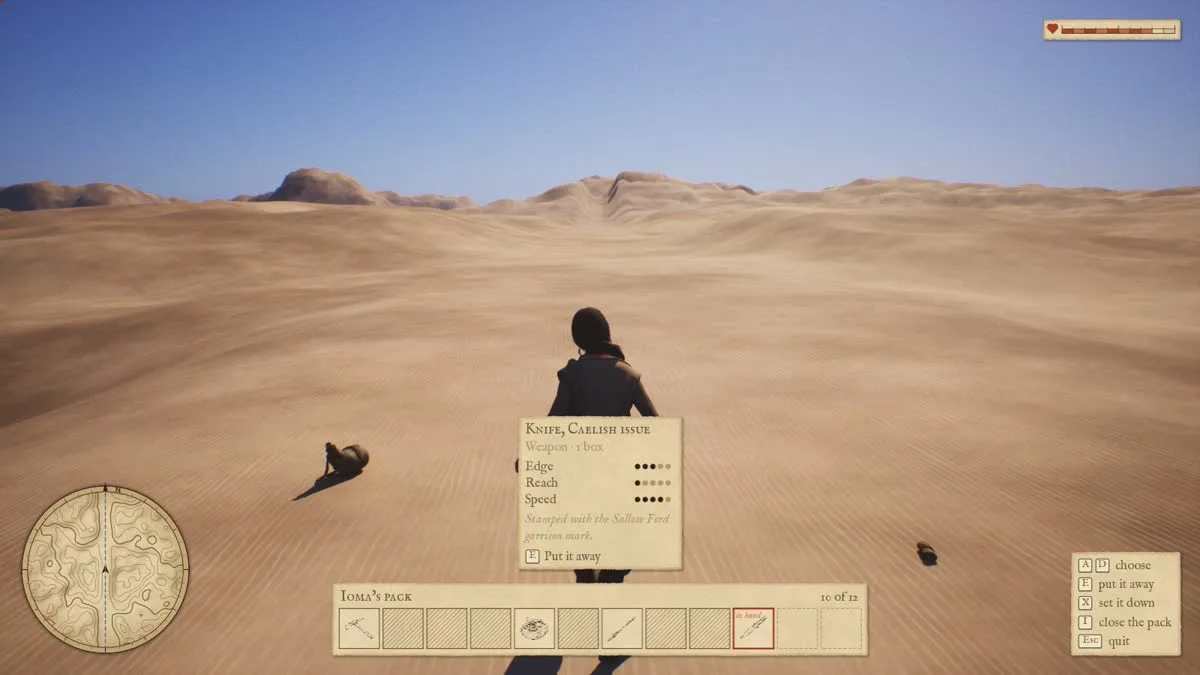
I opens the pack along the bottom of the frame and the scene stands still. A and D choose; E holds a weapon or tool, or eats food; X sets it down.
The rules are the simulation's, like her walking: items lie on the ground or in a pack, and Take, Drop, Equip and Eat are commands, tested and replayed bit for bit (tests/replays/pack_take_overflow.json). The view only picks which item is outlined. A whole scripted session of taking, overflowing, eating and dropping, recorded from the game, replays to the same hash.
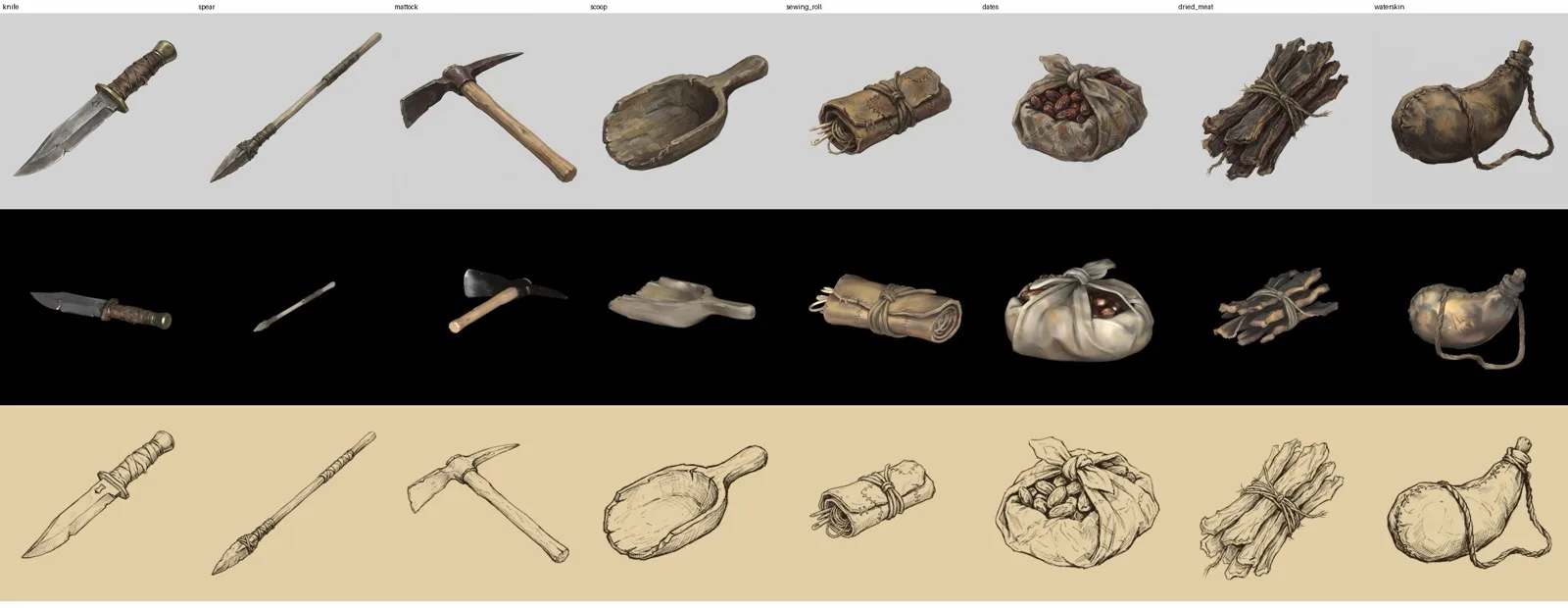
Each item painted in the style of the camp's tent, made into a mesh by Hunyuan, and drawn again in iron-gall ink for its box and tag.
The eight items were painted with the tent's three-quarter repaint as the style reference, turned into meshes through the props pipeline, and sketched in ink from the same paintings. The ink sketches came back on off-white paper that darkens toward the corners, which left a faint square round each icon until the keying measured the paper around each line instead of using a fixed white.
The scene is also the first daylight in the Unreal build: mid-morning, the sun 40° up behind her left shoulder, short hard shadows, a pale dusty sky, at the dusk's own sun brightness and exposure (nothing in the sand clips). The dusk's blue-grey tilt of the sky only went violet as dust was added; turned off, with the aerosols absorbing toward tan, the sky goes pale. The opening is untouched: the traces match and the ride's frame time is 17.1 ms against 17.0 before.
After the first play: the mouse look was too quick (3° a mouse unit, now 1.2), a small reticle now shows the middle of the view the mark is measured from (a paper ring when something is in reach, red with a dot when an item is marked), and set-down things go behind her, where they aren't marked, instead of on a ring round her feet where the next E took them straight back.
Open: the on-foot camera over her shoulder, so the reticle can point at the sand within reach rather than sit on her head; choosing what to drop instead of losing the oldest; weight as a soft cost on a long crossing; and the item in hand drawn on her.
Lowwater is in development. These notes capture the game at the time of writing; plans and visuals may change.